Sunday, December 27, 2009

The Favorites by Mary Yukari Waters


Sarah Rexford, the protagonist of The Favorites, is, like the book's author, half Japanese and half American. In the first part of the novel, she travels with her mother back to Japan to visit her grandmother and aunts, learning much about identity, love, and families in the process.

Sarah's family has an open secret that causes much pain among its members and requires careful politicking to stay ahead of the ever-shifting allegiances. Yoko, Sarah's mother, drills her in the "forward-thinking game," the chess-like practice of considering all the rippling emotional consequences of one's actions before making any move.

It's only by succeeding at this game that Sarah can earn the love of her mother and grandmother, because love in The Favorites is entirely conditional. Sarah's coming of age moment is when she learns to ally with Yoko against her aunt, crossing an "invisible line of allegiance" and realizing that her happiness comes "at the cost of someone else."

The Favorites is a beautiful, heartbreaking novel. Not since Amy Tan's The Joy Luck Club has a book explored the relationships between mothers and daughters so truthfully. I will keep my eye on Waters' forthcoming works.

Water, Mary Yukari. The Favorites. New York: Scribner, 2009. 279 pp.

How Fiction Works by James Wood


In How Fiction Works, James Wood, a staff writer for The New Yorker and a visiting professor in English and American literature at Harvard, returns to an old-school brand of literary criticism and puts the deconstructed novel back together. Like E.M. Forster's Aspects of the Novel, which Wood cites readily, How Fiction Works is an old-fashion primer on literature, a throw-back to a time before the narrative arc of fiction became a mad scientist's laboratory.

That's not to say that Wood's view of literature is limited to the 19th century. He seems to have the entire Western canon at his fingertips, writing about David Foster Wallace and Ian McKeown as fluently as he does the Iliad.

But Wood's major point does center on the 19th century idea of realism. He argues that the test of good fiction is its ability to faithfully represent the interaction of the human mind with the real world. As far as Wood seems to understand them, that mind and world are both fixed absolutes, as are Rules of Literature. His ideas are so quaint that you can almost believe the print date reads 1949 instead of 2009.

As I said, Wood includes an extraordinary breadth of material, from Saramago to Spark, Rulfo to Roth. I love any book that leaves me with a reading list three pages long, as this one did. And I enjoy Wood's unique critical style: he pauses to appreciate the books he is about to critique, as if saying grace before a meal, and blends his analyses with personal asides to remind us why literature matters at all. Politics of academia aside, this is a book you'll love to read, if you love to read.

Wood, James. How Fiction Works. New York: Picador, 2008. 248 pp.

Friday, December 25, 2009

The Orphan's Tales by Catherynne M. Valente


My friend, Dianne, brought Valente to my attention for her critical essay, "Follow the Yellow-Brick Road: Katabasis and the Female Hero in Alice in Wonderland, The Wizard of Oz, and The Nutcracker," which she presented at a Feminism in Sci-Fi/Fantasy Convention in 2005. In the essay, she analyzed the way fairy tale heroines work to contain females. Their arc is small, from birth to marriage, or death.

To remedy the lack of fairy tales for women, Valente has written two volumes of them: In the Night Garden and In the Cities of Coin and Spice. Together, they are The Orphan's Tales, and have won awards as "The Arabian Nights for our time."

The stories Valente weaves are compelling and vibrant. The orphaned girl of the title is discovered by a prince, to whom she tells the stories tattoed on her eyelids that form her own secret history. Each story seems more fantastic and wonderful than the one that came before, and accompanying illustrations, by artist Michael Kaluta, are just as fascinating. And, no, you don't have to be female to appreciate them.

Perhaps we should have entrusted Valente with our fairy tale canon from the very beginning!

Valente, Catherynne M. In the Night Garden. New York: Bantam Dell, 2006. 483 pp.

Valente, Catherynne M. In the Cities of Coin and Spice. New York: Bantam Dell, 2007. 516 pp.

Vanessa and Virginia by Susan Sellers


If you love Virginia Woolf, like I do, you probably think that no one can ever write a book as masterfully crafted as To the Lighthouse. You're right, but you may enjoy this one.

Vanessa and Virginia is meant to be read as a letter from Vanessa Bell to Virginia Woolf after the latter's suicide. Sellers assumes that her readers know the full background of Bell and Woolf, and their relationship, so do your homework before you start this novel, especially since Sellers writes in second person point-of -view, which tends to read like listening to one side of a telephone conversation.

Sellers is very clearly paying homage to Woolf's work, and Bell's role in it. Scenes from Vanessa and Virginia seem lifted almost entirely, word for word, from To the Lighthouse or Mrs. Dalloway. It's humbling to see one artist another in this way, but it is not to Sellers' advantage. She is an excellent writer; her prose is beautifully formed and her taking up the challenge of writing in second person well-met. But let her give us something different, something original. This is her first novel. I am eager to read the second.

Sellers, Susan. Vanessa and Virginia. Boston: Houghton Mifflin Harcourt, 2009. 224 pp.

Wednesday, December 23, 2009

7 Wheelchairs: A Life Beyond Polio by Gary Presley


"The beauty of disability is the beauty of being human" (157). So writes Gary Presley, whose book, 7 Wheelchairs: A Life Beyond Polio, recounts his life as a paraplegic. But don't let a single quote mislead you; Presley does not try to glorify his situation in his memoir. He spends chapters going into extensive detail about his bowel movements (or lack thereof), the urinal he carries with him everywhere, and his pride in still being able to have an erection.

Presley contracts polio from a vaccine when he is 17, and spends most of the first two decades of his paralysis raging against his fate. He harbors resentment toward everyone -- himself included -- and everything for what is difficult in his life. Then, gradually, through several dynamic points, Presley learns to appreciate what he does have and stop dwelling in the negative.

This is what he wants us to do, as well. Presley includes the graphic details of having to sit in his own feces because there is no one around to move him to his bedpan because he wants us to read 7 Wheelchairs and think, "Wow, this guy has it really hard. Compared to him, I am so fortunate."

And we are, but -- as Presley reminds us several times throughout his memoir -- so is he.

Presley, Gary. 7 Wheelchairs: A Life Beyond Polio. Iowa City, Iowa: University of Iowa Press, 2008. Print.

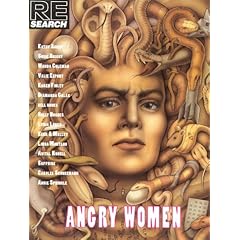
Angry Women, Edited by Andrea Juno and V. Vale


Andrea Juno founded the small, independent press, Juno Books, that printed Angry Women, its sister book, Angry Women in Rock, and many other subculture texts. According to Juno, her goddess namesake encompassed a wide range of female experiences in "lunar/matriarchal times."

Juno Fortuna, Fate; Juno Lucina, Light; Juno Martialis, the Warrior -- to name only a few. Also, every woman had a "juno," which was the name for her soul, just as every man had a "genius." When the solar/patriarchal societies took over the lunar/matriarchal societies, the goddesses became denigrated. Juno became the jealous, hysterical wife...Suddenly Juno is the "property" of Jupiter, inferior to him. (152)

Juno -- Andrea Juno, that is -- and all the Angry Women she interviews in this book make it their primary focus to restore the female goddess to her rightful place. They want to show women -- through visual and performance art, literature, and music -- that we don't need to chase after male genius when we possess our own female junos. To be "angry" in the Junian sense of the word is to be empowered and able to relate to men without needing to take anything away from them.

In terms of style, Juno presents her female subjects in interviews, but the journalism conventions end there. There is nothing objective about Juno's approach, nor even the acknowledgment that maintaining some detachment from one's subject might be desirable. Juno is the first to express and provoke anger, often losing sight of reason along the way. Consider, for example, her statement to Diamanda Galas that "the only form of gun control I would support is that women could own guns and men couldn't" (22).

Angry Woman ignited my thoughts and sparked my passions. And, most importantly, it gave me a phenomenal reading list for delving more deeply into feminist art and literature. If you're a woman, and you're angry -- and if you're a woman, you should be -- get your hands on a copy.

Angry Women. Eds. Andrea Juno and V. Vale. New York: Juno Books, 1991. Print.

Monday, December 21, 2009

The Search for God at Harvard by Ari L. Goldman


Whether intentionally or not, Goldman's account of his year at Harvard's Divinity School provides an apt illustration of his world religion's teacher, Diana Eck's lesson: "If you know one religion....you don't know any." The religion Goldman knows is Orthodox Judaism, and though he peppers his narrative with anecdotes about his Muslim friend or his Christian Scientist friend, it is Orthodox Judaism that is his main focus. More specifically, it is his struggle to recognize his deep religiosity with a modern, secular world that is forms the meat of this book.

There are very few Orthodox Jewish journalists. The news does not stop, whereas the Torah teaches us that God rested on the seventh day....and so should we. Jews consider it one of the most sacred rituals to observe the Sabbath from sundown on Friday to sundown on Saturday. So how should Goldman, a cub reporter trying to work his way up as a copy boy at The New York Times, answer the question, "Do you work weekends?"

Chapter after chapter, Goldman tries to put religion -- both specific religions and in general -- in perspective. He is in over his head when he is talking about world religions like Buddhism, misunderstanding the nuance in that philosophy between desire and love, but is in his element when reminiscing about his personal history and spiritual journey. The Search for God at Harvard should not be read as a religious text or a final word on the subject by any means, but can be enjoyed as the personal narrative of a man struggling -- as we all do -- with faith.